
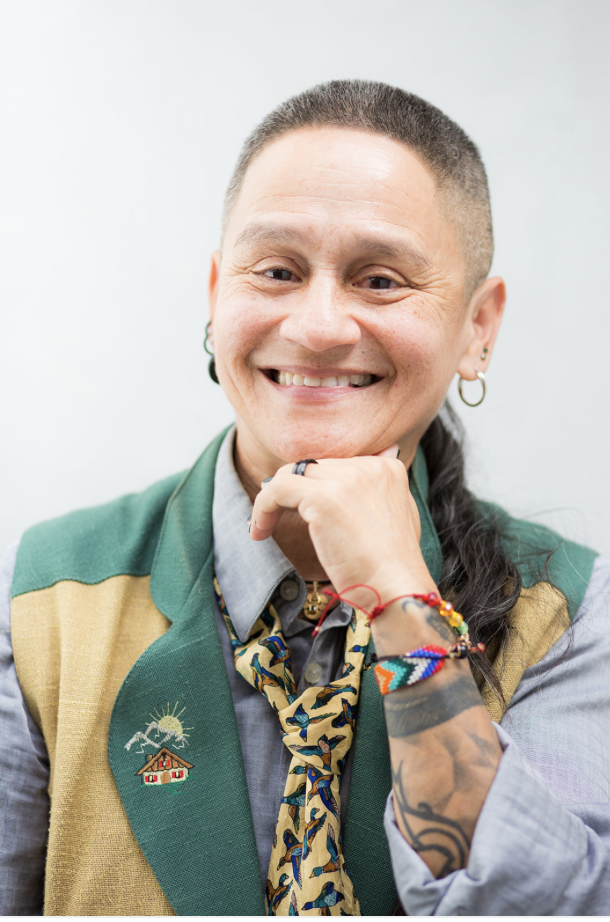
Based at Alice Billing House, we spoke with one of our studio desk holders, a poet, organiser, and founder of Newham Poetry Group, Sonia, about their practice and the community work that has shaped their journey. Writing across languages, identities, and lived experiences, their work centres on belonging, access, and collective creativity. In this conversation, they reflect on building inclusive cultural spaces in Newham, the role of poetry in wellbeing and social connection, and what it means to create a movement rooted in care, visibility, and shared voice.
Can you tell us a bit about yourself and your role within Newham Poetry Group?
I would love to say that I am a poet and stop there. But I am also very aware of the multiple and intersectional identities I hold, and stopping there would not support the visibility I stand for.
I am a Colombian British, lesbian poet and immigrant. I am also a community activist, community builder, cultural organiser, artist, and poet. I carry all of these identities with me, not as labels, but as lived experiences that shape how I write, how I listen, and how I organise. I have published five books of poetry in Spanish and three in English, writing across languages, geographies, and forms. Language, for me, is not just a tool but a territory I move through, negotiate, and sometimes resist.
I am the founder and organiser of Newham Poetry Group, a role that is as much about care, holding space, and collective imagination as it is about poetry itself.
What is Newham Poetry Group, and what inspired its creation?
Newham Poetry Group (NPG) is a volunteer-led, not-for-profit community group. Ten years ago, after a few years in London and following an existential crisis, one rooted in questions about my identity and my sense of belonging, and whether I would ever truly find that here, I began to reflect deeply on what it means to belong. I was terrible missing my voice as a poet and my creative community. I began looking for spaces where I could express my passion for poetry and find a sense of community, a place to belong.
What I mostly encountered in poetry and creative spaces were academic and, very often, Eurocentric approaches to poetry. I felt frustrated when I realised that my metaphors did not quite land, that my use of personification, repetition, and playful structures was not fully welcomed. Those spaces did not know what to do with my language, my cultural references, or my way of writing.
So I decided to create the space I was looking for. I started a group where people like me could find respect, acceptance, and a genuinely welcoming environment. A space that welcomed skills, languages, cultures, and identities. A place of celebration rather than competition. A place of recognition rather than invisibility. A place where we are all just poets, nothing less, nothing more.
Today, it is no longer just me. We are a movement of around 25 people gathering every week. Many have been there since the very beginning, and some are now part of the organising team and facilitators of the group.
Since 2016, we have organised uninterrupted weekly poetry sessions at Stratford Library; seasonal poetry sessions at Forest Gate, Manor Park, Canning Town, Green Street, and East Ham libraries; published four poetry anthologies; delivered one Young Poetry Festival and three Newham Poetry Festivals; and hosted countless open mics, spoken word events, poetry cafés, and special celebrations. Our work has marked LGBTQ+ History Month, Refugee Week, Black History Month, and many other significant moments.
We have performed at universities and cultural institutions, including UEL, the University of Westminster, and the Royal Museums Greenwich. And our journey continues—with the same commitment: to inspire people, to ensure they find a place where their voices matter, and to amplify those voices as much as we can.
What are the core values or aims of the group?
At its core, Newham Poetry Group is about belonging. It exists to create a space where people do not have to translate themselves, dilute their voices, or leave parts of who they are at the door in order to be heard. Our values are rooted in care, access, and equity. We believe poetry should not be competitive, hierarchical, or gatekept by academic or cultural norms. Instead, we work to make poetry a shared, collective practice, one that welcomes different languages, accents, forms, life experiences, and ways of writing.
We centre respect, acceptance, and visibility. That means actively valuing people’s identities, cultures, and stories, particularly those that have been historically marginalised or silenced. We hold space for poets to experiment, to take risks, to be vulnerable, and to grow, without fear of judgment or exclusion. We are also deeply committed to community. Our aim is not just to support individual writers, but to build long-term relationships, mutual support, and collective confidence. Many people come to NPG looking for poetry and stay because they find connection, solidarity, and a sense of home.
Ultimately, our aim is simple but political: to ensure that everyone who enters the space knows that their voice matters, and that it will be heard, respected, and amplified.
Why is it important to you that creative activities are accessible to everyone in Newham?
Because access is never neutral. Newham is one of the most diverse boroughs in the country, shaped by migration, working-class histories, survival, care, and constant change. Yet the people who live here are too often excluded from cultural spaces, by cost, by language, by confidence, and by unspoken rules about who art is for and how it should be made.
For me, accessibility is deeply personal. As an immigrant and a lesbian, I know what it feels like to enter spaces where your presence is tolerated but not fully imagined, where parts of who you are remain unspoken or unseen. When creative activities are inaccessible, they reproduce the same exclusions many people already face in education, employment, and public life. Making creative activities accessible in Newham is about more than offering free sessions. It is about meeting people where they are, geographically, culturally, emotionally. It is about recognising libraries, community centres, and public spaces as sites of knowledge and creativity, and honouring lived experience as expertise.
When people can access creative spaces without barriers, something shifts. Confidence grows. Stories emerge. Connections are formed. People begin to see themselves not only as participants, but as creators, organisers, and cultural producers. For me, ensuring access is both an act of care and a political commitment. It is about redistributing who gets to speak, who gets to be seen, and whose stories are valued. In a place like Newham, that work is not optional, it is essential.
How does poetry and creative writing support wellbeing and social connection in the community
Poetry and creative writing create spaces where people can breathe again. I noticed this more clearly than ever after Covid. When we returned to in-person sessions, there was a visible shift in who was coming through the door and in what people were carrying with them. Many arrived with grief, exhaustion, anxiety, and a deep sense of disconnection. Others came looking not only to write, but to feel human again, to be seen, to sit with others without having to explain why things felt heavy.
Creative spaces became more than places of expression. They became spaces of support, dialogue, and repair. Writing allowed people to process what had happened, to name loss, fear, and uncertainty, but also to imagine continuity and hope. Listening to each other’s words helped rebuild trust and a sense of collective presence.
This feels especially urgent in the current political climate. We are living through an increasingly aggressive environment marked by uncertainty, rising hostility, and the growth of far-right movements. For many people, particularly migrants, LGBTQ+ communities, and other marginalised groups, this creates a constant background of vulnerability and fear. In that context, creative spaces offer something rare: safety without silence, and dialogue without harm.
Poetry does not fix structural violence, but it does something essential. It allows people to articulate what is often pushed into the margins, to connect through shared experiences, and to realise they are not alone. Social connection grows not from forcing positivity, but from honest, collective reflection.
In our sessions, wellbeing emerges through relationship, through writing together, listening deeply, and recognising each other’s stories as valuable. Poetry becomes a bridge: between individuals, between differences, and between what hurts and what is still possible.
What kinds of projects and activities does Newham Poetry Group run?
Newham Poetry Group works across generations, spaces, and formats, always rooted in community and access. We have delivered a wide range of creative projects for young people in local schools, including Sarah Bonnell School, Schools 21, Newham College, and the University of East London, as well as in youth centres such as REIN, Forest Gate Youth Centre, Stratford Youth Centre, and Stratford Youth Centre. Alongside this, Newham’s public libraries have been central to our work, hosting regular sessions, workshops, and community-led creative activity.
Our programme includes both long-term projects and large-scale public events. Over the years, we have organised and delivered borough-wide celebrations including Black History Month (2018, 2019, 2021), LGBTQ+ History Month (2018, 2019, 2021) in collaboration with the London Borough of Newham, and Newham Heritage Month from 2021 to 2024. We have also led National Lottery Heritage–funded projects between 2021 and 2022, exploring local histories, memory, and belonging through poetry and creative practice. We are the founders and organisers of the Newham Poetry Festival, which has run annually from 2022 to 2024 with support from Arts Council England. These festivals bring together emerging and established poets, young people, and residents, creating inclusive cultural moments rooted in place. We have also organised and delivered Refugee Week programmes in partnership with Royal Museums Greenwich in 2021, 2022, 2024, and 2025, as well as with the University of Westminster. These projects centred refugee voices, storytelling, and creative expression as tools for visibility, solidarity, and public engagement.
Alongside creative programming, we have contributed to civic and democratic spaces, including delivering work as part of Newham’s Community Citizen Assembly between 2019 and 2021, using poetry and storytelling as tools for dialogue, reflection, and participation.
What has been your experience of working creatively in such a culturally diverse borough like Newham?
Working creatively in Newham has been one of the most grounding and transformative experiences of my life. Newham is not a neatly curated version of diversity. It is lived, layered, sometimes messy, and deeply human. People arrive carrying different languages, migration histories, faiths, wounds, joys, and ways of seeing the world. As a poet, an immigrant, and a lesbian, I recognise that complexity because I live it too. Creatively, this means that no single narrative dominates the room. Poems move between languages, registers, and rhythms. Stories are shaped by displacement and belonging, by survival and care, by humour and grief. Working in Newham has taught me to listen differently, to slow down, and to value process over polish.
It has also made me very aware of power. Cultural diversity does not automatically mean equity. Some voices are still quieter, more hesitant, shaped by fear, trauma, or long histories of exclusion. Creating space in Newham means actively resisting hierarchy, making room for uncertainty, and building trust over time. What continues to move me is how much generosity exists here. People show up week after week, often after long workdays, caring responsibilities, or unstable living situations, still willing to share their words and listen to others. Creativity becomes a shared language when spoken words fall short.
Newham has taught me that culture is not something you bring into a community. It is something that already exists, waiting to be recognised, supported, and amplified. Working here has shaped not only my practice as a poet, but my understanding of solidarity, care, and what it truly means to build community through art.
What can participants expect from your upcoming workshop with us?
Participants can expect a welcoming, inclusive space where lived experience is valued as knowledge and poetry becomes a tool for mapping memory, identity, and belonging. The workshop will invite people to explore Newham through personal stories, streets, emotions, and futures, using writing as a way to connect place with self. There will be gentle prompts, time to write, space to share if people wish, and an emphasis on care, respect, and collective listening. No previous writing experience is needed, just curiosity and a willingness to explore how our lives and the places we move through shape who we are and who we are becoming.
The workshop is not about producing a “perfect” poem, but about creating connection, reflection, and possibility.
Why do you think poetry is a powerful way to explore place, identity, and belonging?
Because poetry allows us to speak from the in-between. Place, identity, and belonging are not fixed or linear, especially for people shaped by migration, queerness, or displacement. Poetry makes room for contradiction, for fragmented memories, for feelings that do not yet have a clear language. It allows us to hold more than one truth at the same time. Poetry is embodied. It carries accents, silences, rhythms, and pauses. It remembers streets, smells, gestures, and moments that official maps often erase. Through poetry, place becomes lived rather than abstract, and identity becomes something felt rather than explained. Most importantly, poetry does not demand certainty. It invites curiosity, listening, and connection. In doing so, it creates a space where people can recognise themselves and each other, and where belonging is not prescribed but collectively imagined.
What does being part of a community-led creative group mean to you personally?
For me, being part of a community-led creative group means not having to carry everything alone. It means shared responsibility, shared care, and shared imagination. It means building something collectively, slowly, and with intention, rather than chasing visibility, prestige, or individual recognition. In community-led spaces, leadership is relational, listening matters as much as speaking, and people are valued for who they are, not just for what they produce. Personally, it has been a way of finding home. As an immigrant and a queer poet, community-led creative spaces have offered me continuity, trust, and belonging in a world that often feels unstable and exclusionary. They have allowed me to grow as a poet, organiser, and person, while staying accountable to others.
Being part of this kind of group is both grounding and political. It is an everyday practice of solidarity, care, and resistance, one that reminds me that creativity, when held collectively, can sustain us for the long term.
How can people get involved with Newham Poetry Group or take part in future activities?
The best way to get involved is to come along to one of our weekly poetry sessions. We gather every week at Stratford Library at 6.15pm. Registration and participation are completely free and open to all. People who haven’t attended before, we simply ask to register in advance by emailing newhampoetrygroup@gmail.com. This helps ensure that everyone has the chance to read our values and vision in advance, so the space remains respectful, welcoming, and aligned with the care we hold for one another.
This year marks ten years of our movement, and as we celebrate that milestone, we are also looking outward, ready to spread our poetry seeds beyond where we began. There will be new projects, collaborations, and opportunities to connect in different ways. To stay updated, keep an eye on our website and follow us on Instagram and Facebook, where we share upcoming sessions, events, and ways to take part. Whether people join us weekly or cross paths with us through a project or festival, there is always room in the circle.
Sonia will be facilitating a Poetry Workshop Queer Maps of Newham: Stories, Streets, and Futures, Wednesday 25 February, 18:15 - 20:00, FREE BOOK HERE